
Morgan County Release Date Types
A projected release date is a forward-looking date. It is not the same as the actual jail or prison release event. For an Alabama state-prison inmate, the key public field is the ADOC "Minimum Release Date." ADOC defines that field as the earliest scheduled date an inmate can be released to probation or end of sentence. ADOC also warns that the date can change when good time is revoked, new cases arrive from a circuit clerk, or the sentence changes.
A Morgan County Jail release works differently. A county detainee may bond out, be released on an own-recognizance order, finish a short jail sentence, be released after a dismissal or other court order, or be transferred to ADOC, BOP, ICE, or another county. A transfer ends local custody but does not mean release to the community. For a short county sentence, the release date should be confirmed against the court order and jail release record.
Scheduled vs actual: A scheduled or minimum date is a planning field. The actual release is confirmed by the jail, ADOC, court record, VINE notice, or supervision agency record.
Morgan County ADOC Date Lookup
For a sentenced state prisoner from a Morgan County case, the Alabama Department of Corrections inmate search is the current-custody starting point. ADOC says the database contains currently incarcerated inmates only and that historical data is not available online. That limitation is important. If the person has already left ADOC custody, the public search may not show a current record. After release, use ADOC public records, ABPP, Alabama VNS, and court records.
- Search by AIS if known. ADOC says the six-digit AIS takes precedence over name fields.
- If AIS is unknown, search first and last name, using partial names only when needed.
- Confirm identity with court records, known sentence details, or other reliable identifiers.
- Read the Minimum Release Date field if the person is currently in ADOC custody.
- Compare Good Time Received, Good Time Revoked, Jail Credit, Parole Consideration Date, and Parole Status.
- If the person is no longer in the current search, use ADOC records, ABPP, Alabama VNS, and the Morgan County court file.
The ADOC definitions page is the source for the field names used in a Morgan County release date lookup. The screenshot below is useful because it shows the definitions source tied to Minimum Release Date and related sentence fields.
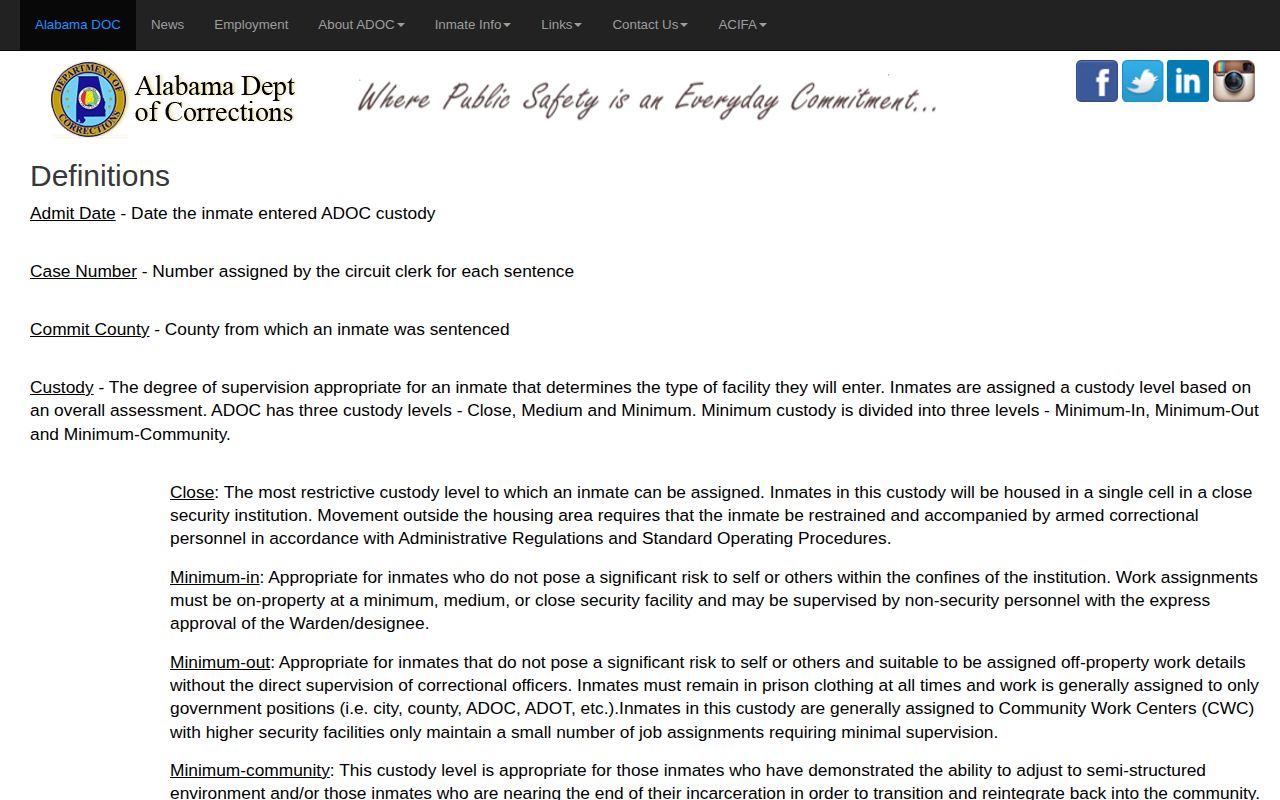
Those ADOC definitions help explain why a state-prison date can move after a court update, good-time change, or sentence change.
Morgan County Release Date Fields
Release-date research should compare several fields, not just one date. A person can have a minimum release date, a parole consideration date, a parole status, and a court sentence record that all say different things. They answer different questions. The minimum date estimates the earliest scheduled state release. The parole date relates to board processing. Jail credit comes from county court records. The actual release record shows what happened.
| Field | Where it comes from | How to use it |
|---|---|---|
| Minimum Release Date | ADOC definitions and current inmate search | Earliest scheduled state release to probation or end of sentence. |
| Good Time Received | ADOC record field | Shows incentive time credited where the person is eligible. |
| Good Time Revoked | ADOC record field | Shows incentive time removed through discipline. |
| Jail Credit | Circuit clerk sentencing information | Counts qualifying county jail time applied to a sentence. |
| Parole Consideration Date | ABPP process | Shows board processing timing, not guaranteed physical release. |
| Release date | Jail, ADOC, BOP, court, or records request | Confirms the custody event after it happens. |
For Morgan County cases, the Circuit Clerk can matter because ADOC says jail credit is prepared by the circuit clerk of the sentencing county. A changed sentence, new case, or corrected jail credit can affect the state release date. Court records are not a side issue; they can be part of the calculation.
Morgan County Good-Time Rules
Alabama correctional incentive time is governed by Ala. Code 14-9-41. It should not be reduced to one simple percentage. Eligibility and amount can depend on the offense, sentence length, sentence class, institutional classification, conduct, and statutory exclusions. The research identifies key exclusions such as Class A felonies, life and death sentences, sentences over 15 years, certain deadly-weapon death cases, and child sex offenses as defined in state law.
Good time can also be lost. ADOC's field definitions include Good Time Revoked, and ADOC says Minimum Release Date can change when disciplinaries remove good time. This is why a date seen earlier can differ from a later date without the first search being fake. The underlying sentence may be the same, but the credit calculation or court information may have changed.
Do not state that Alabama has a universal 85 percent release rule for all prisoners. The research supports a more careful rule: Alabama release dates are driven by sentence terms, jail credit, correctional incentive time, statutory exclusions, parole eligibility, mandatory release, split-sentence law, discipline, and court updates. Federal BOP releases use federal calculations, not Alabama law.
Morgan County Mandatory Release
Mandatory release to supervision is separate from ordinary county-jail release and ordinary parole. Alabama's mandatory supervision period is governed by Ala. Code 15-22-26.2. ABPP states that it applies to offenses committed on or after January 30, 2016, with child sex offenders and life sentences excluded. ADOC determines eligibility and coordinates with ABPP.
The published ABPP ranges depend on sentence length. For five years or less, release to supervision is no less than three and no more than five months before end of sentence. For more than five but less than ten years, it is no less than six and no more than nine months. For ten years or more, it is no less than twelve and no more than twenty-four months. Those ranges describe supervision timing, not the Morgan County Jail 48-hour release display.
For a Morgan County person leaving prison under mandatory release, check ADOC for current custody before release, Alabama VNS for eligible notification, and ABPP for supervision routing. The local post-release supervision page is the better route once the question changes from "when is release" to "who supervises the person after release."
Morgan County Parole Date Limits
ABPP says parole eligibility is calculated under Ala. Code 15-22-28. Sentence, offense, jail credit, ability to earn good time, time served, and sentencing orders can affect the calculation. A parole "set date" is not a guaranteed hearing date. It is a month and year for file processing after eligibility. That means a parole date should not be read as the day someone will walk out.
If parole is granted, ABPP says release is coordinated after home-plan verification. A grant is a board action, not always a same-day physical release. Watch the ADOC custody record, Alabama VNS, VINE where applicable, ABPP records, and the court file for the actual event. If parole is denied with reset, ABPP says the reset month and year are the first point for possible future docket placement, not a new release date.
Note: A parole grant can explain a future release path, but it is not a final Morgan County release record by itself.
Morgan County Release Date Changes
A release date can change for reasons that are routine in sentence administration. Some changes come from prison discipline. Some come from a Morgan County court update. Others come from a hold, detainer, transfer, parole decision, or federal custody path. The best method is to identify which agency controls the date, then check the source that can explain that change.
| Reason the date changes | Likely source to check | Why it matters |
|---|---|---|
| Good-time loss | ADOC fields and records | Discipline can revoke credit and move Minimum Release Date. |
| New case or sentence change | Morgan County court record and ADOC | ADOC says circuit clerk updates can change the calculation. |
| Jail credit correction | Morgan County Circuit Clerk | County jail time may affect sentence time served. |
| Parole grant or denial | ABPP hearing results and ADOC | Board action can alter the route, but release still must be coordinated. |
| Transfer or hold | Jail, ADOC, BOP, ICE, court | Leaving one custody system may not mean release to the community. |
Morgan County Jail Release Timing
A Morgan County Jail detainee may not have a projected release date at all. Pretrial release can depend on bond posting, own-recognizance order, court order, dismissal, hold release, or transfer. A short sentence can depend on time served and jail credit. Morgan County publishes a 48-hour recent-release window, but that window reports recent releases after they happen. It is not a calendar of scheduled release dates.
For a current Morgan County Jail person, start with the current roster and court record. For a person who just left jail, use the sheriff's 48-hour release view and VINE where registered. For an older jail release, use the sheriff's public-record request process or Morgan County Circuit Clerk records. When the exact release reason matters, the court record usually explains more than a roster card.
Morgan County court records are especially useful for bond and sentence timing. The sheriff's bonds page explains that a person can make bail before all paperwork has reached the courthouse for case-number assignment. That means a jail release may appear before the court file looks complete online. For a short sentence, the sentence order, jail credit, and release record need to be read together.
The VINE inmate check can help when a release has not happened yet and an alert is needed. The formal release date still comes from the agency or court record.
Confirm Morgan County Release Date
Use the source that owns the custody event. For Morgan County Jail, that means the sheriff, jail records, VINE, and the court file. For an ADOC sentence, use ADOC fields before release, then ADOC records, Alabama VNS, and ABPP if supervision applies. For federal custody, use BOP, USMS, ICE, or federal court. A date copied from the wrong system can lead to the wrong conclusion.
- Projected date
- A planned or calculated future date that can change before release.
- Actual release date
- The custody event date after the jail or prison ends custody for that person.
- Parole consideration date
- A board-processing date, not proof that release has occurred.
- Jail credit
- Time credited from county jail toward a sentence when recognized by the court and corrections system.
- Discharge
- The end of a custody or supervision term, which is different from a temporary transfer or court reset.
For ADOC records that are no longer visible in the public current-inmate search, use ADOC public records and keep the request narrow. Ask for the release or discharge record tied to the known AIS, sentence, and Morgan County case information. Narrow requests are easier to route than broad requests for every record about a person.